
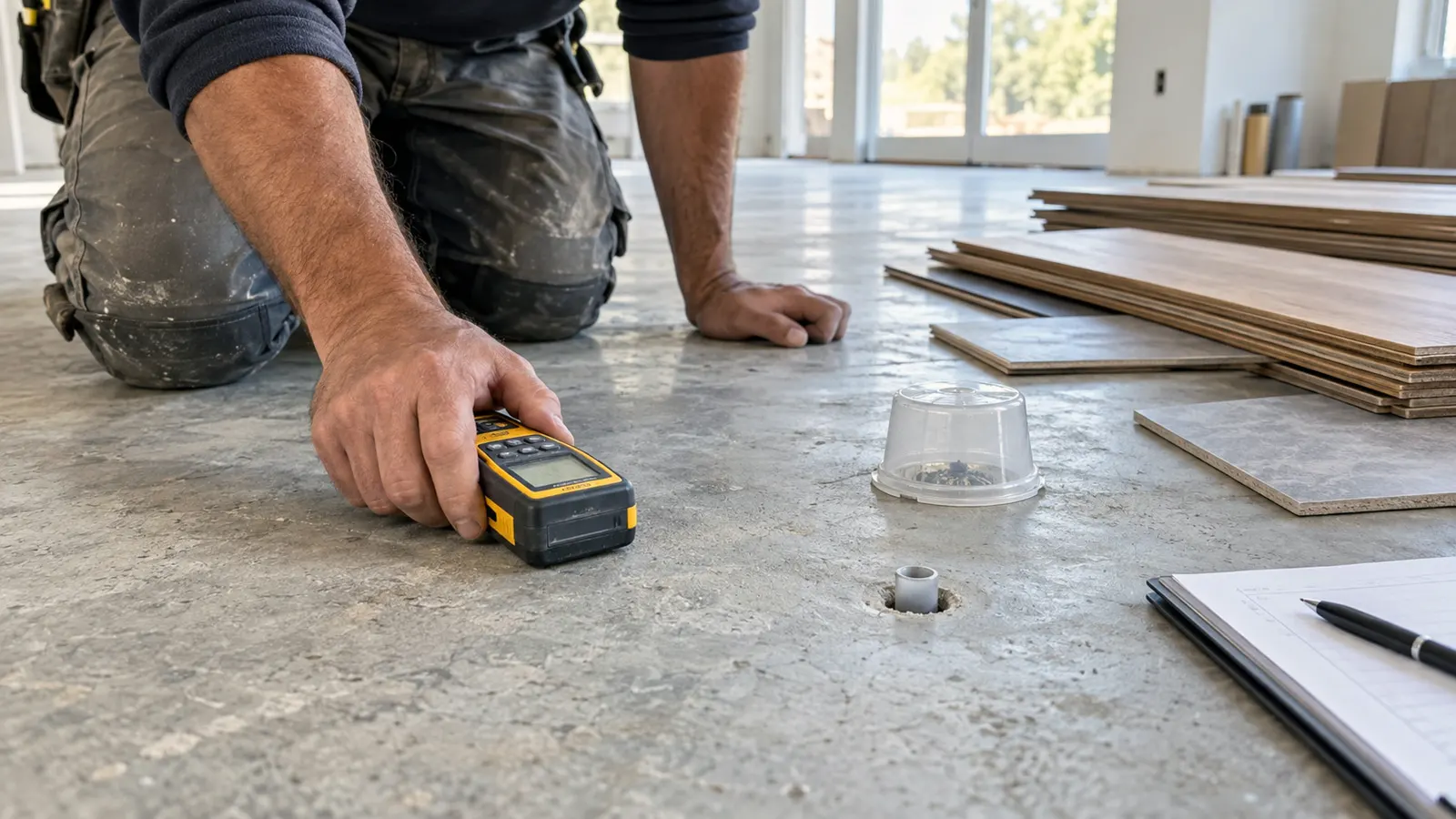
A concrete slab can look dry, feel dry and still contain enough moisture to create problems after flooring is installed. That is why concrete moisture testing should be part of the preparation process before installing moisture-sensitive flooring, adhesives or coatings.
The important question is not simply, “Is the concrete dry?” It is whether the slab meets the moisture requirements of the specific flooring system you plan to install.
Different concrete moisture tests measure different things. An in-situ relative humidity test measures conditions inside the slab. A calcium chloride test measures moisture vapor emission from the surface. A concrete moisture meter can quickly map moisture conditions near the surface, while a plastic sheet test can only provide a basic indication that moisture is present.
Those results are not interchangeable, and there is no single moisture number that makes every concrete floor ready for every type of flooring.
The safest approach is straightforward: identify the flooring system first, check its installation requirements, use the specified test method, compare the results with the flooring and adhesive limits, and investigate further when the results are uncertain.
Why Concrete Moisture Matters Before Flooring Installation
Concrete contains water from the time it is mixed, and drying continues long after the slab has hardened enough to walk on. Moisture conditions can also change later because of ground moisture, environmental conditions, leaks or an ineffective vapor retarder beneath the slab.
Installing flooring changes the way moisture can leave the surface. A slab that appeared trouble-free while exposed may behave differently after it is covered with vinyl, wood flooring, carpet, an underlayment, adhesive or a resinous coating.
Excess moisture can contribute to adhesive failure, debonding, deterioration of flooring or coatings, dimensional changes in moisture-sensitive materials and other installation problems.
This is also why the age of a slab is not a reliable moisture test. An older slab can still have a moisture problem, while a newer slab may already meet the requirements of a particular flooring system.
Moisture testing provides information about the slab at the time and locations tested. It does not guarantee that conditions can never change. The condition of the vapor retarder beneath an on-grade slab, drainage around the building and future environmental conditions all remain relevant.
Concrete Moisture Meters for Preliminary Slab Testing
If you need to survey a concrete floor before more detailed testing, several professional non-destructive meters are designed specifically for slab mapping and comparative moisture evaluation. These tools are useful for locating areas that may require additional investigation, but they should not replace ASTM F2170 or another required quantitative test when the flooring specification calls for one.
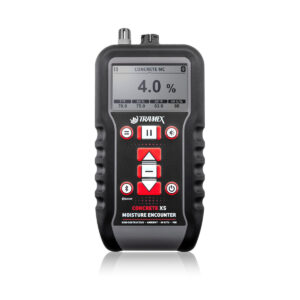
Tramex CMEX5 Concrete Moisture Encounter X5
- Meter Type
- Pinless
- Measurement Material
- Concrete
A high-end digital concrete moisture meter for flooring and coating professionals, combining non-destructive concrete MC readings, built-in environmental measurements, Bluetooth documentation and…
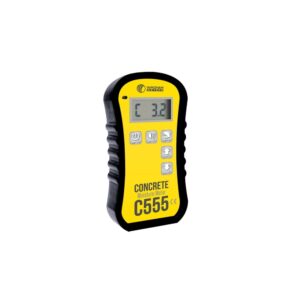
Wagner C555 Concrete Moisture Meter
- Meter Type
- Pinless
- Measurement Material
- Building Materials, Concrete, Masonry
A strong dedicated concrete screening meter for flooring professionals who need fast non-destructive slab mapping, environmental conditions and field calibration before deciding…
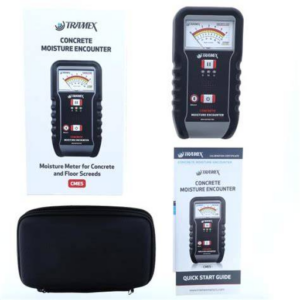
Tramex CME5 Concrete Moisture Encounter
- Meter Type
- Pinless
- Measurement Material
- Concrete
A professional non-destructive concrete moisture meter built for flooring and coatings work, with instant concrete moisture readings, ASTM F2659 comparative testing and…
What to Check Before Testing a Concrete Slab
Before choosing a concrete moisture test, start with the flooring rather than the testing equipment.
Find the installation instructions for the exact flooring product, adhesive, primer, underlayment or coating system you intend to use. Look specifically for the required moisture test method, allowable result and any additional requirements such as concrete pH testing or a moisture mitigation system.
This step matters because two flooring systems installed over the same concrete slab may have very different moisture tolerances.
You should also understand what type of slab you are testing. An on-grade slab that dries primarily through its upper surface is different from a suspended slab that can dry from both sides. Lightweight concrete can require different testing rules from normal-weight concrete, and some moisture test methods are not appropriate for it.
Check whether the slab is bare. Adhesive residue, curing compounds, sealers, coatings, patching products and existing flooring can interfere with certain tests or make them unsuitable unless the test method specifically allows those conditions.
The environment matters as well. Flooring moisture tests are normally performed under controlled or expected service conditions rather than in a building that is temporarily much hotter, colder, wetter or drier than it will be after occupancy.
Finally, use extra caution before drilling a slab for in-situ testing. Post-tensioned concrete, radiant heating systems and embedded electrical or plumbing components can make drilling hazardous. If the slab construction is unknown, professional evaluation is the safer option.
Main Concrete Moisture Testing Methods
Understanding what each test actually measures is more important than choosing the fastest test.
| Test method | What it evaluates | Best use | Main limitation |
|---|---|---|---|
| In-situ relative humidity – ASTM F2170 | Relative humidity inside the concrete slab | Flooring installations that require documented internal RH testing | Requires drilling and correct test placement and conditioning |
| Calcium chloride – ASTM F1869 | Moisture vapor emission rate from the concrete surface | Flooring systems that specifically accept MVER testing | Measures surface emission at the time of testing and is not suitable for every concrete type |
| Concrete moisture meter – ASTM F2659 | Comparative moisture condition in the upper portion of the slab | Fast screening, moisture mapping and locating areas for further testing | Usually should not be treated as a standalone installation pass/fail test unless the flooring manufacturer allows it |
| Plastic sheet – ASTM D4263 | Indicates the presence of capillary moisture | Preliminary screening | A negative result does not prove that the slab is sufficiently dry for flooring |
| Concrete pH testing | Surface alkalinity | Checking compatibility with resilient flooring, adhesives and some coating systems | It is not a moisture measurement |
In-Situ Relative Humidity Testing
In-situ relative humidity testing is performed by drilling into the concrete slab and measuring relative humidity within the slab rather than only at its surface.
The method is covered by ASTM F2170.
This is important because moisture is not necessarily distributed evenly through a drying slab. The surface may be considerably drier than the concrete deeper below it.
Probe depth depends on how the slab is drying. Current industry guidance commonly places probes at approximately 40 percent of the slab thickness when the slab is drying from one side, such as many on-grade slabs, and approximately 20 percent when it can dry from both sides. Exact test placement, number of test locations, conditioning and reading procedures should follow the current ASTM standard and probe manufacturer’s instructions.
The main advantage of in-situ RH testing is that it provides a quantitative measurement from inside the concrete.
Its main disadvantage for homeowners is that it requires drilling, suitable probes and careful test procedures. For a small DIY project, it may be more practical to have an installer or moisture-testing professional perform the test when the flooring manufacturer requires ASTM F2170 documentation.
Calcium Chloride Testing
The anhydrous calcium chloride test is covered by ASTM F1869 and measures the moisture vapor emission rate, usually abbreviated as MVER.
The result is expressed as pounds of moisture emitted per 1,000 square feet of concrete over a 24-hour period.
A prepared area of bare concrete is exposed beneath a sealed test dome containing calcium chloride. The material absorbs moisture emitted from the slab, allowing the emission rate to be calculated after the required test period.
This is a quantitative test, but it evaluates moisture emission at the concrete surface rather than relative humidity deeper inside the slab. Environmental conditions, surface preparation and the condition of the slab at the time of testing therefore matter.
ASTM F1869 also has limitations regarding the substrates on which it can be used. For example, it should not simply be applied to lightweight concrete as an alternative to an appropriate internal RH test.
Use calcium chloride testing when the exact flooring, adhesive or project specification accepts ASTM F1869. Do not choose it merely because a test kit is readily available.
Concrete Moisture Meters
A concrete moisture meter is often the fastest way to begin evaluating a slab.
Non-destructive meters can take many readings across a floor without drilling a hole at every location. This makes them especially useful for identifying patterns and finding areas that appear wetter than the rest of the slab.
ASTM F2659 covers the preliminary evaluation of comparative moisture conditions in concrete and other floor slabs using non-destructive electronic moisture meters. The method evaluates the upper portion of the slab rather than the full internal moisture profile.
That distinction is important.
A concrete moisture meter can be an excellent screening and mapping tool without necessarily being the final test that determines whether flooring can be installed.
For example, an installer can scan a large slab, identify higher-reading areas and then place in-situ RH tests in locations that deserve closer investigation.
Some professional concrete moisture meters provide concrete moisture-content scales, comparative readings, environmental measurements and digital reporting. These features can make testing more useful, but the number on the display still needs to be interpreted according to the meter manufacturer’s instructions and the flooring system being installed.
If you are comparing equipment for this purpose, the Podovi.org Concrete Moisture Meters section of our Moisture Meters category covers tools designed for concrete and flooring applications.
Plastic Sheet Testing
The plastic sheet method is one of the simplest ways to check whether moisture is visibly accumulating at a concrete surface.
ASTM D4263 describes a plastic-sheet procedure for indicating the presence of moisture in concrete. A sheet of plastic is sealed to the concrete for a specified period and the area is then inspected for visible moisture or darkening.
For a homeowner, this can be a useful warning test.
If condensation or a darkened concrete surface appears under the plastic, further investigation is clearly justified.
The reverse conclusion is much more dangerous. If nothing appears under the plastic, that does not prove that the slab meets the requirements for vinyl, hardwood, laminate, carpet, epoxy or another flooring system.
A plastic sheet test is therefore best treated as preliminary screening, not installation clearance.
Concrete pH Testing
Concrete pH testing answers a different question.
It evaluates alkalinity at the concrete surface rather than the amount of moisture in the slab. High alkalinity can affect certain flooring adhesives and installation systems, particularly in resilient flooring applications.
ASTM F710, which addresses preparing concrete floors to receive resilient flooring, calls for concrete slabs to be evaluated for moisture and for concrete floors to be tested for pH before resilient flooring installation.
This does not mean every floor has the same acceptable pH range. The flooring and adhesive manufacturers determine the limits for the products being installed.
Moisture and pH should therefore be treated as related installation checks rather than as substitutes for one another.
Which Moisture Test Is Best for Your Flooring?
There is no universally best concrete moisture test. The best test is the one required by the flooring system and appropriate for the condition you are trying to measure.
If the flooring or adhesive instructions specify ASTM F2170, use in-situ RH testing. A surface moisture meter does not automatically replace it.
If ASTM F1869 is an accepted method, a properly performed calcium chloride test can provide the required MVER value.
If you are surveying a large concrete floor and want to identify moisture patterns before placing more detailed tests, a non-destructive concrete moisture meter is often the most efficient starting point.
For a homeowner investigating an unexplained moisture concern, a meter or plastic sheet test can provide useful preliminary information. When the flooring installation has a warranty, involves a large area or depends on an adhesive or coating with specific moisture limits, documented testing is a better basis for the installation decision.
In practical terms, the sequence often works best as screening first and verification second.
Moisture Considerations for Different Flooring Types
Different floors react differently to concrete moisture, and the installation system can matter as much as the visible flooring material.
| Flooring type | Main moisture consideration | Practical approach |
|---|---|---|
| Vinyl, LVP and LVT | Adhesive, backing and resilient-flooring system requirements can be moisture and pH sensitive | Check the exact flooring and adhesive instructions for accepted ASTM test method and limits |
| Hardwood and engineered wood | Concrete moisture, wood moisture content, ambient RH and vapor control all matter | Test the slab and wood flooring, then follow the flooring and adhesive manufacturer’s concrete-subfloor requirements |
| Laminate | Concrete moisture and vapor protection requirements are product-specific | Follow the exact laminate installation instructions and required concrete moisture test |
| Tile | Tile itself may tolerate moisture differently from the complete installation system | Check requirements for mortar, membranes, primers, stone and other components |
| Carpet | Backing, adhesive and installation method determine moisture tolerance | Follow the carpet and adhesive manufacturer’s concrete requirements |
| Epoxy and other coatings | Concrete moisture, surface condition and environmental conditions can directly affect coating performance | Use the test method and threshold specified by the exact coating system |
Vinyl, LVP and LVT
Resilient flooring is one of the clearest examples of why concrete moisture testing should be system-specific.
A floating rigid-core vinyl product, a glue-down LVT product and a commercial sheet vinyl system can all have different requirements despite being grouped broadly as vinyl flooring.
For glue-down installations, the adhesive may have its own RH, MVER and pH limits in addition to the flooring manufacturer’s instructions.
Do not assume that a waterproof finished surface means the flooring can be installed over unlimited moisture from below.
Hardwood and Engineered Wood
Wood flooring adds another variable because the flooring itself responds to moisture.
A proper evaluation can include ambient temperature and relative humidity, moisture content of the wood flooring, the condition of the concrete slab, the installation method and the vapor-control or adhesive system.
The National Wood Flooring Association emphasizes moisture testing as part of wood-flooring installation quality control and recognizes ASTM F2170, ASTM F1869 and ASTM F2659 in different roles.
A concrete moisture meter can help survey the slab, but a project that requires a quantitative ASTM test should still receive that test.
Laminate Flooring
Laminate flooring manufacturers commonly specify concrete moisture requirements and may require a vapor barrier over concrete.
The exact numbers should come from the installation instructions for the product you are using rather than from a generic online chart.
This is especially important because similar-looking laminate products can have different installation systems, underlayments and moisture requirements.
Tile
Ceramic and porcelain tile are often viewed as less moisture-sensitive than wood or resilient flooring, but that does not make concrete moisture irrelevant.
The complete installation includes bonding mortars, membranes, primers, grouts and sometimes moisture-sensitive stone or other materials. Existing moisture can also be evidence of a larger water or vapor problem that should be understood before the floor is covered.
Use the requirements of the complete tile installation system rather than assuming that the tile itself determines the acceptable slab condition.
Carpet
Carpet installed over concrete may use adhesives, cushion systems or backing materials with specific substrate requirements.
A slab that is acceptable for one carpet installation system may not automatically be acceptable for another.
As with resilient flooring, check the exact flooring and adhesive documentation before selecting the test method.
Epoxy and Other Concrete Coatings
Resinous flooring and coatings can be particularly dependent on substrate preparation and moisture conditions.
Product data sheets commonly specify concrete moisture limits, test methods, surface preparation requirements and environmental conditions such as relative humidity and dew point.
This is another area where a generic statement such as “concrete must be below X percent moisture” can be misleading. The specified coating system should control the decision.
How to Interpret Concrete Moisture Test Results
The first rule is not to compare numbers from different tests as though they measure the same property.
An in-situ RH result is expressed as relative humidity inside the slab.
A calcium chloride test produces a moisture vapor emission rate.
A non-destructive concrete moisture meter may display a concrete moisture-content value, a comparative scale or another manufacturer-specific reading.
A pH test measures alkalinity rather than moisture.
These values cannot simply be converted into one universal concrete moisture percentage.
The next step is to identify the allowable result for the complete flooring system. That can include the flooring, adhesive, primer, underlayment and moisture-control product.
Current manufacturer guidance shows why this matters. For example, Pergo’s published concrete installation guidance gives limits of 5 pounds per 1,000 square feet per 24 hours for calcium chloride testing or less than 80 percent RH using an in-situ probe for the installations covered by that guidance. By contrast, Armstrong Flooring’s S-1000 commercial adhesive is specified for certain porous concrete applications at much higher moisture conditions, including up to 100 percent RH or 25 pounds per 1,000 square feet per 24 hours.
Those numbers are not competing definitions of “dry concrete.” They belong to different flooring systems.
The correct response is not to choose whichever manufacturer allows the highest moisture level. It is to follow the requirements of the exact products being installed.
If a result exceeds those limits, the options may include allowing more drying time, investigating the moisture source, changing the installation system or applying an approved moisture-mitigation system. The appropriate choice depends on the slab and the products involved.
Common Concrete Moisture Testing Mistakes
Treating a Moisture Meter as Automatic Installation Approval
A non-destructive meter is fast and extremely useful for mapping a concrete floor, but ASTM F2659 describes a preliminary comparative evaluation. Unless the flooring manufacturer specifically accepts the meter and its readings as an installation criterion, use it to guide further testing rather than as an automatic pass/fail tool.
Testing Only One Location
Concrete does not necessarily dry uniformly. Exterior walls, cracks, plumbing areas, previous water exposure and differences in slab construction can produce different conditions across the same room.
A single reading can therefore miss the area that ultimately causes the problem.
Assuming a Dry Surface Means a Dry Slab
Surface conditions can change quickly. Moisture deeper inside the concrete may not be obvious from appearance or touch.
This is one reason internal RH testing and surface MVER testing provide different information.
Using the Wrong Test for the Concrete Type
Not every ASTM method applies to every substrate. Lightweight concrete is a particularly important example because calcium chloride testing should not automatically be used as a substitute for an appropriate RH method.
Identify the substrate before choosing the test.
Ignoring Jobsite Conditions
Testing a slab while the building is operating under temporary construction conditions can produce data that does not represent the environment expected during normal occupancy.
Follow the environmental requirements of the test method and flooring manufacturer.
Applying One Moisture Limit to Every Floor
Perhaps the most common mistake is searching for a single “acceptable concrete moisture level.”
There is no useful universal number for every flooring product.
A result that is unacceptable for one adhesive may be permitted by another system specifically designed for higher-moisture concrete. The flooring, adhesive and underlayment documentation should determine the threshold.
Forgetting pH and Other Substrate Requirements
Passing a moisture test does not automatically mean that the concrete is ready for flooring.
Surface cleanliness, strength, flatness, pH, curing compounds, coatings, cracks and contamination can all affect the installation. Moisture testing is one part of substrate evaluation.
When to Hire a Professional
DIY screening can be useful when you are trying to understand whether a small residential concrete floor may have a moisture issue. A non-destructive moisture meter can help identify patterns, and a plastic sheet can reveal an obvious moisture condition that deserves more investigation.
Professional testing becomes more valuable when the test result will determine whether an expensive floor should be installed.
Consider professional help when the flooring or adhesive requires ASTM F2170 or another documented procedure, the slab covers a large area, readings vary significantly across the floor, previous flooring has failed, water intrusion is suspected, the slab is lightweight or post-tensioned, radiant heating is embedded in the concrete, or a moisture mitigation system may be required.
Professional testing does not make the slab dry. Its value is that it provides more reliable, documented information for deciding what to do next.
Final Checklist Before Flooring Installation
- Identify the exact flooring, adhesive, underlayment and primer you plan to use.
- Read their current concrete-subfloor and moisture requirements.
- Determine whether the slab is on-grade, suspended, lightweight or another construction type.
- Check whether an effective vapor retarder exists beneath the slab when that information is available.
- Confirm that the selected moisture test is accepted by the flooring or adhesive manufacturer.
- Use a concrete moisture meter for screening and mapping when appropriate, not automatically as a substitute for a required ASTM test.
- Perform in-situ RH, calcium chloride or other specified testing according to the current standard and equipment instructions.
- Interpret each result in its own units rather than attempting to convert different test methods into one generic moisture percentage.
- Compare results with the limits for the exact flooring system.
- Check pH and other substrate requirements when required.
- Investigate unexpected, inconsistent or excessive readings before covering the slab.
- Document the test locations, environmental conditions and results for projects where installation approval or warranty requirements matter.
Concrete moisture testing is ultimately a decision tool. The goal is not to find a number that makes the slab “dry.” The goal is to determine whether the concrete is suitable for the flooring system you are about to install.
Start with the flooring manufacturer’s requirements, choose the test that measures the condition those requirements address, document the results and resolve moisture problems before they become flooring problems.