
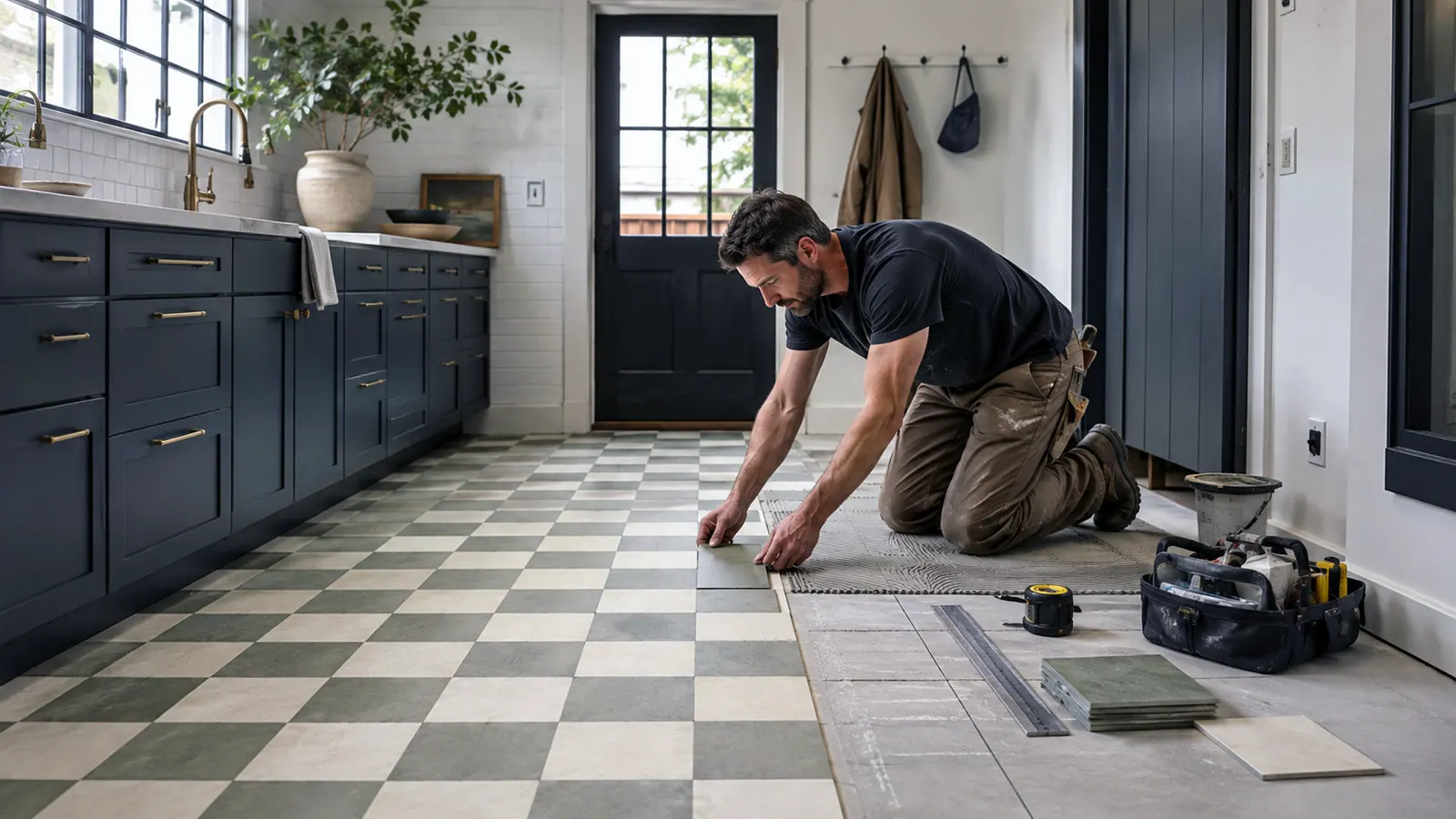
Checkerboard vinyl flooring offers a practical way to introduce a strong geometric pattern without committing to the weight, hardness or installation demands of stone and ceramic tile. The visual idea may be familiar, but the material behaves very differently – and those differences matter when choosing the right floor.
A vinyl checkerboard can be bold and graphic, warm and understated or surprisingly sophisticated depending on the colors, scale and surface finish. It can imitate marble or limestone, use clean solid colors or rely on subtle tonal variation to make the geometry feel less rigid.
But appearance is only part of the decision.
Two vinyl floors can look almost identical in photographs and perform very differently once installed. Construction, wear layer, surface texture, dimensional stability, installation method, water resistance and the quality of the subfloor all influence how the finished floor looks and how well it performs over time.
That is why choosing checkerboard vinyl flooring should begin with more than finding two colors that work together.
If you are still deciding whether vinyl is the right material for the pattern, our broader guide to checkerboard floors explores different materials, colors, pattern scales and applications throughout the home.
Why Choose Checkerboard Vinyl Flooring?
Vinyl makes checkerboard accessible to rooms and renovation projects where natural stone or ceramic tile may not be the most practical option.
It is generally warmer and more forgiving underfoot than hard tile, which can make a noticeable difference in kitchens, laundry rooms and other spaces where people spend long periods standing. Depending on the product and installation system, it can also simplify renovations where additional floor thickness, weight or extensive substrate preparation would otherwise create problems.
That practical flexibility is one of vinyl’s strongest advantages.
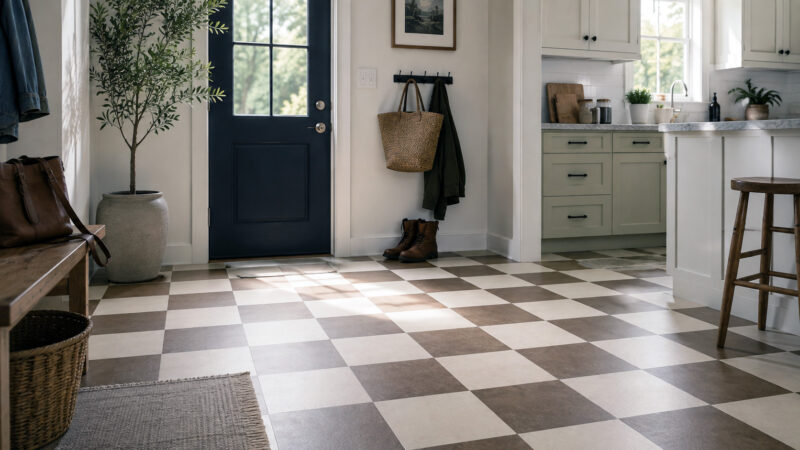
The pattern can still be visually assertive, but the material does not have to be. Cream and brown can sit quietly beneath warm wood cabinetry. Sage and ivory can introduce color without dominating a utility room. Black and warm white can create a sharper graphic floor without automatically making the interior feel retro.
Vinyl also allows different interpretations of the same checkerboard idea. Some products reproduce marble or limestone with subtle veining and tonal variation, while others use clean, solid colors that make the geometry itself the main design feature.
The important thing is not to assume that vinyl automatically means compromise.
A well-selected product can look convincing, feel comfortable and perform very well in the right space. The opposite is also true. Thin construction, obvious print repetition, an excessively glossy surface or poor installation can make a checkerboard floor look inexpensive very quickly.
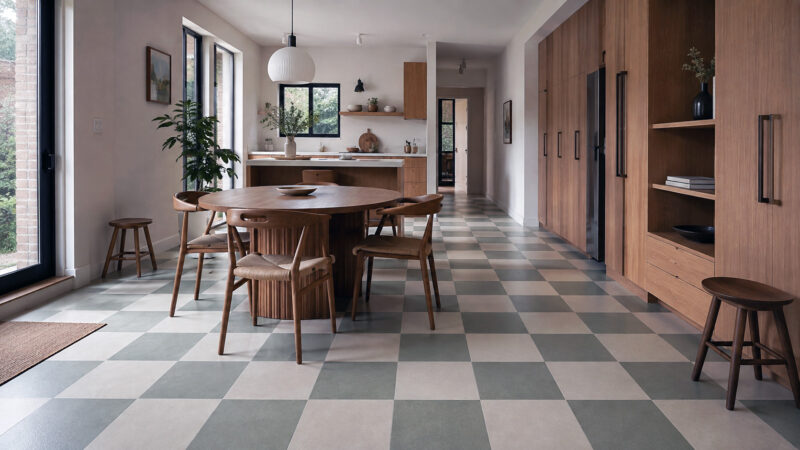
Comfort Matters More Than It Seems
One of the clearest differences between vinyl and stone or ceramic is the way the floor feels.
Vinyl is generally softer and warmer underfoot. It will never feel soft in the way carpet does, and the exact result depends on the product and substrate, but the difference from a hard mineral floor is usually noticeable.
For a kitchen where someone may stand at a worktop for long periods, that can be more valuable than having the most authentic stone surface possible.
Vinyl Can Be Renovation-Friendly
Vinyl can also be useful when working with limited floor build-up height or an existing substrate.
Some products may be installed over suitable existing surfaces when all manufacturer requirements are met, while others need more extensive preparation or a new underlayment. Either way, vinyl can sometimes make a checkerboard renovation less disruptive than completely rebuilding the floor assembly for ceramic or stone tile.
That does not mean preparation can be ignored.
In fact, checkerboard can expose poor preparation particularly clearly because every square creates a precise visual reference.
There Is More Design Freedom Than Black and White
Checkerboard vinyl is not limited to a traditional black-and-white floor.
Warm neutrals make the geometry quieter. Muted green or blue-gray introduces color without turning the floor into the only thing you notice. Stone-look surfaces soften the pattern, while flat colors make it more graphic.
Pattern scale changes the result as well. Smaller squares create more repetition and movement. Larger squares make the floor calmer and more architectural.
Vinyl therefore allows the same basic checkerboard idea to work in interiors that have very little in common stylistically.
But that freedom only helps if the product itself is suitable for the room.
Vinyl makes checkerboard easier to achieve, but it does not make every checkerboard vinyl product equally good.
Which Type of Checkerboard Vinyl Flooring Should You Choose?
Not all vinyl checkerboard floors are built the same way.
The finished pattern may look similar, but the product underneath can differ considerably in construction, installation, repairability and performance.
The main choices are vinyl tile, luxury vinyl tile, sheet vinyl and peel-and-stick tile. Each can produce a checkerboard appearance, but each solves a different set of practical problems.
Vinyl Tile
Traditional checkerboard vinyl tile is one of the most direct ways to create the pattern because individual squares are installed one by one in alternating colors.
That gives you considerable control over the layout. You can decide where the pattern begins, how the colors alternate and whether the grid runs straight or diagonally.
It also makes precision extremely important.
If one row begins to drift, that error repeats across the room and becomes more noticeable with every additional tile.
Individual tiles can have another advantage: repairability. Depending on the product and installation system, a damaged tile may be replaced without removing a large section of flooring.
For kitchens, laundry rooms, mudrooms and similar spaces where localized damage is possible, that can be useful.
Dimensional consistency should not be overlooked. Small differences in tile size that might disappear in a random pattern can create visible alignment problems in a checkerboard grid.
Luxury Vinyl Tile (LVT)
Checkerboard LVT flooring can provide a more substantial and realistic surface than basic vinyl tile, especially when the product uses high-quality printing, subtle embossing and a durable wear layer.
For stone-look checkerboard floors, LVT can be particularly effective because it can recreate aspects of marble, limestone or other natural materials while remaining warmer and more forgiving underfoot.
However, not every LVT product can automatically be combined into a checkerboard.
Two colors must be compatible in dimensions, thickness, edge construction and installation system. Mixing unrelated products simply because they look good together can create problems with locking profiles, edge height, movement or installation requirements.
Where possible, work within a compatible product family or follow the flooring manufacturer’s recommendations.
A beautiful combination that does not install correctly is not a good combination.
Sheet Vinyl
Checkerboard sheet vinyl approaches the pattern differently.
Rather than constructing the checkerboard from individual pieces, the entire pattern may already be printed into the sheet.
This can reduce the number of seams across the main floor area and create a continuous surface that is straightforward to clean. It can work particularly well in kitchens, laundry rooms and practical spaces where individual tile joints are not desirable.
The trade-off is flexibility.
With separate tiles, you control colors, orientation and layout. With sheet vinyl, pattern scale and color combinations are predetermined by the product.
Repairs can also be more difficult to disguise if damage occurs in the middle of the floor.
Still, if the goal is a checkerboard appearance with relatively few seams and a continuous practical surface, sheet vinyl deserves serious consideration.
Peel-and-Stick Vinyl Tile
Peel-and-stick tile is often the most accessible DIY option.
The tiles are lightweight, easy to handle and available in many checkerboard-friendly colors. For a small room or budget renovation, that simplicity is attractive.
But simple application should not be confused with simple preparation.
The adhesive depends heavily on the quality of the substrate. Dust, uneven areas, residue or an incompatible surface can affect the bond, and checkerboard still requires careful alignment.
For temporary upgrades or low-cost projects, peel-and-stick products can work well. For heavy traffic or a long-term installation, product quality and adhesive performance become much more important.
Vinyl Tile, LVT, Sheet Vinyl or Peel-and-Stick?
| Type | Best For | Installation | Repairability | Water Handling | Visual Realism |
|---|---|---|---|---|---|
| Vinyl Tile | Kitchens, laundry rooms, mudrooms | Moderate | Often good | Product-dependent | Good |
| LVT | Kitchens and higher-spec interiors | Moderate | Product-dependent | Product-specific | Very good |
| Sheet Vinyl | Kitchens, utility rooms, larger practical areas | More specialized | Harder to patch invisibly | Fewer seams can help | Good to very good |
| Peel-and-Stick | Small DIY and budget projects | Relatively simple | Often easy | Product-dependent | Varies widely |
If maximum control over the checkerboard is important, individual tiles usually make the most sense.
If fewer seams are the priority, sheet vinyl has a clear advantage.
If you want a more substantial surface and convincing stone effects, LVT may provide the best balance – provided the product system supports the checkerboard layout you want.
How to Choose the Right Checkerboard Vinyl Floor
Once the type of vinyl is decided, the next question is not simply which two colors look best together.
Pattern scale, surface texture, print quality, wear layer, construction and intended use all influence whether the finished floor looks convincing and performs well.
Checkerboard is particularly unforgiving because it is repetitive and ordered. Small differences that might disappear in another floor can become obvious when every square relates directly to the next one.
Decide How Much Contrast You Want
Black and white remains the easiest checkerboard combination to recognize, but it is far from the only option.
Black paired with warm white creates strong graphic contrast. Cream and brown feels quieter and works naturally with timber. Sage and ivory introduces color without becoming overly decorative, while charcoal and cream retains much of the classic checkerboard character but softens the transition between squares.
Contrast determines how quickly the eye notices the floor.
A high-contrast checkerboard becomes an important part of the room’s architecture. Lower contrast allows the pattern to behave more like texture.
So rather than asking which sample looks most impressive on its own, consider a more useful question:
How much attention should the floor receive once the cabinetry, furniture, walls and lighting are all in place?
A kitchen with strongly veined worktops, dark cabinetry and multiple finishes may benefit from a quieter floor. A simpler room may need stronger checkerboard contrast to give it structure.
Choose Pattern Scale in Relation to the Visible Floor
Smaller squares create more repetition and movement. Larger squares create fewer transitions and usually feel calmer.
Medium-format patterns are often the easiest to work with because they remain clearly recognizable without overwhelming the space.
But room size alone is not enough to determine the scale.
A large kitchen dominated by an island and cabinetry may expose surprisingly little floor. A smaller entryway may reveal almost every square.
It is the amount of visible floor, not simply the room’s dimensions, that should influence the pattern scale.
Stone-Look or Solid Color?
Stone-look vinyl can soften the checkerboard by adding subtle veining, clouding and tonal variation inside each square.
That works especially well with cream, brown, gray and muted green combinations because it prevents the grid from feeling too rigid.
However, printed stone brings one potential problem: repetition.
If the same vein appears repeatedly in the same position, the manufactured nature of the product can become obvious across a large checkerboard floor.
Whenever possible, look at several tiles or a larger installed sample rather than judging the product from one piece.
Solid-color vinyl takes the opposite approach.
Instead of imitating stone, it allows the geometry to carry the design. Black and warm white, charcoal and cream or muted color combinations can look excellent when paired with a matte or low-sheen finish.
Vinyl does not need to pretend to be marble in order to look good.
Sometimes the more convincing choice is the product that is comfortable being vinyl.
Wear Layer and Product Quality Matter More Than Photography
Two products can have almost identical colors and patterns while being intended for very different levels of use.
The wear layer protects the decorative surface from abrasion, but it should not be judged in isolation. Overall construction, surface treatment, dimensional stability and intended application all matter.
A product designed for a lightly used room does not face the same demands as one installed in a busy family kitchen.
Checkerboard also makes dimensional consistency particularly important. If individual tiles vary in size or behave differently after installation, the grid can begin to look uneven even when the floor remains technically usable.
Surface texture matters visually too.
A matte or low-sheen finish often hides everyday marks more effectively and can look more convincing than an overly glossy surface. Stone-look products may benefit from subtle texture, but deep embossing only helps when it makes sense for the material being reproduced.
Do not choose the floor only because the product photography is good.
Look at the material itself.
Check Print Repetition Before Buying
Printed flooring introduces something natural stone does not: repeat graphics.
Good products use enough pattern variation that repetition becomes difficult to detect across the room.
Checkerboard can make weak repetition easier to notice because the geometric grid already creates order.
If several cream tiles contain exactly the same vein in exactly the same location, that repetition may become obvious surprisingly quickly.
It is a small detail while shopping, but across a complete room it can strongly influence whether the floor feels convincing.
Water Resistance Is Product-Specific
It is tempting to reduce the decision to a simple statement: vinyl is waterproof.
That is too broad.
The performance of a completed floor depends on the specific product, construction and installation system, including joints, seams, perimeter details and the substrate underneath.
Some vinyl floors are specifically designed for moisture-prone rooms. Others come with limitations.
Sheet vinyl reduces the number of seams across the main field, while individual tiles create more joints. Neither observation alone determines whether the floor is suitable for a bathroom or laundry room.
Manufacturer specifications should.
The flooring surface may tolerate water very well while the complete installation still has additional requirements.
Consider the Subfloor Before Committing to the Product
Vinyl’s relatively low thickness is one reason it works well in renovations.
That same characteristic can make the condition of the substrate more important.
Depending on the product, imperfections can telegraph through the finished surface or affect adhesion and alignment. With checkerboard, changes in level may be even easier to notice because the straight grid gives the eye such a strong reference.
Before buying the floor, understand what preparation the existing substrate requires.
A beautiful product can become an expensive mistake if the installation budget assumes it can simply be placed over a surface that is not suitable.
How to Install Checkerboard Vinyl Flooring
Checkerboard vinyl may look simple, but the pattern is less forgiving than many other floors.
A wood-look plank floor can hide small alignment errors because joints are staggered and grain creates visual variation. Checkerboard does the opposite.
Every square contributes to a larger grid.
A small error can therefore repeat across the room and become more obvious as installation progresses.
Good preparation and accurate layout matter more than speed.
Prepare the Subfloor Properly
When you prepare a subfloor for vinyl tile, the aim is generally to create a surface that is clean, dry, stable and sufficiently flat for the specific product.
Dust, adhesive residue, raised fasteners, cracks, uneven patches and changes in level can affect appearance, bonding and performance.
Because vinyl is relatively thin, imperfections beneath it may become visible through the finished surface depending on the construction.
Existing floors require the same caution.
Some vinyl products can be installed over certain existing surfaces. Others require removal, underlayment or additional preparation.
Do not assume that avoiding floor removal also means avoiding preparation.
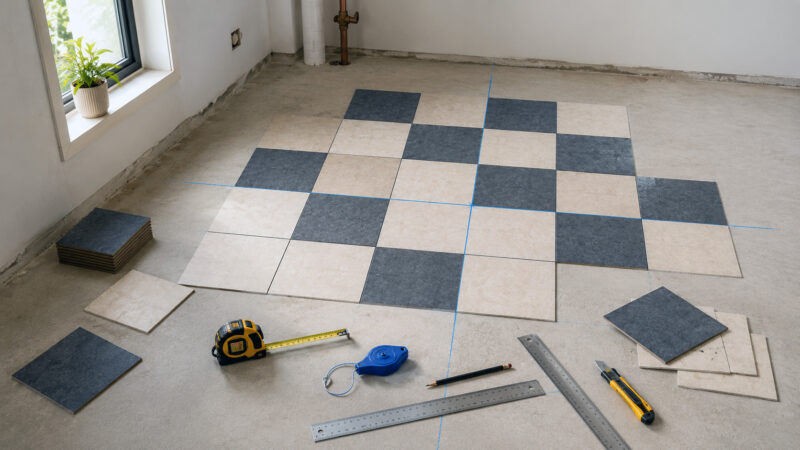
Plan the Checkerboard Before Installing Anything Permanently
Starting from the nearest wall may seem logical, but walls are not always straight or square.
Following a slightly crooked wall can transfer that error through the entire checkerboard.
Instead, establish reliable reference lines based on the room and its important sightlines.
Depending on the space, that might mean working from the center, establishing perpendicular lines or aligning the grid with a kitchen island, major doorway or main cabinetry run.
The guiding principle is simple:
Plan the floor around what the eye will notice, not around the easiest place to start.
Dry-laying several rows can reveal problems before adhesive or locking systems make changes difficult.
Look at the resulting cuts along opposite walls, through doorways and around cabinetry. Moving the entire grid by part of a tile can sometimes produce much more balanced perimeter pieces.
Keep the Grid Square
Once installation begins, alignment needs to be checked continuously.
A small alignment error that might disappear in a wood-look floor becomes obvious when every square is expected to line up with the next.
Do not rely only on the previously installed row. Continue checking against the primary reference lines.
If one tile rotates slightly, the neighboring joint changes. The next tile then follows that changed line, and the error can gradually spread.
This is also why combining unrelated vinyl products can be problematic. Even very small dimensional differences can disrupt the grid.
Straight or Diagonal?
A straight checkerboard follows the architecture of the room and usually feels calmer and more contemporary.
It is often easier to plan because perimeter cuts remain relatively simple and the grid relates naturally to walls, cabinetry and islands.
A diagonal checkerboard creates more movement.
It can work particularly well in entryways and visually simple rooms, but it creates more angled perimeter cuts and generally requires additional planning.
Vinyl may be easier to cut than ceramic or stone, but that does not make layout errors less visible.
Adhesive, Click and Peel-and-Stick Systems
Glue-down vinyl tile should always be installed according to the flooring and adhesive manufacturer’s specifications.
Working time, adhesive transfer, rolling and curing requirements vary between systems.
Click-lock LVT introduces a different constraint: the locking system determines how pieces can connect. A checkerboard layout is only appropriate when the product allows the alternating configuration required.
Two LVT tiles that appear to have identical dimensions cannot automatically be assumed to be compatible.
Peel-and-stick flooring looks simpler, but substrate preparation becomes even more important because the adhesive relies directly on the quality and cleanliness of the surface.
Easy to stick down does not mean easy to align correctly.
Sheet Vinyl Requires Pattern Positioning Rather Than Individual Tile Alignment
With checkerboard sheet vinyl, the geometry may already be printed into the material.
That removes the need to align hundreds of individual squares but creates another challenge: the entire pattern needs to sit correctly in relation to walls, cabinetry and doorways.
Where more than one width of material is needed, seam placement and pattern matching become especially important.
Geometric patterns make mismatched seams difficult to hide.
Plan Edge Cuts Before They Become a Problem
A checkerboard floor can be technically correct and still look poorly planned if it finishes with very narrow strips along a prominent wall.
Perimeter cuts should therefore be considered before installation starts.
Doorways deserve particular attention because people naturally notice how geometric flooring moves through an opening.
The same is true around islands and cabinetry.
A good checkerboard appears to continue logically through the architecture rather than simply ending wherever the measurements happened to land.
When Professional Installation Makes Sense
Many small, rectangular vinyl tile projects may be manageable for an experienced DIY installer.
Professional installation becomes more valuable when the subfloor requires significant correction, the room has irregular geometry, several openings interrupt the pattern, sheet vinyl requires pattern matching or a diagonal layout creates complex perimeter cuts.
Checkerboard looks simple because every piece is square.
In reality, that simplicity exposes every mistake.
Where Does Checkerboard Vinyl Work Best?
Checkerboard vinyl can be used in many parts of the home, but its strongest applications are usually rooms where the floor needs to combine visual character with practical performance.
The correct product matters more than the room name alone.
Traffic, moisture, cleaning frequency and installation method all need to be considered.
Kitchen
The kitchen is one of the most natural places for checkerboard vinyl flooring.
Vinyl’s warmer, more forgiving feel can be valuable in a room where people spend considerable time standing, while checkerboard works particularly well with the strong architectural lines created by cabinetry and islands.
Black and warm white produces a sharper result. Cream and brown, sage and ivory or charcoal and cream can create a quieter floor that is easier to integrate with timber and stone finishes.
Kitchen flooring, however, needs to tolerate more than good photography.
Traffic, spills, dropped objects, moving chairs and frequent cleaning all matter.
Wear layer, surface treatment, product rating and water performance should therefore be considered before color.
Bathroom
Checkerboard can give a small bathroom considerable character without requiring highly decorative walls.
Vinyl may also seem like an obvious choice because of its reputation for water resistance, but bathrooms are where product specifications become particularly important.
Not every vinyl flooring system is intended for every bathroom application.
A powder room exposed primarily to occasional splashes presents a very different environment from a frequently used bathroom with a shower.
Confirm that the specific flooring and installation method are approved for the intended application.
From a design perspective, medium-scale and lower-contrast checkerboards often work particularly well in smaller bathrooms because they retain the pattern without creating excessive visual activity.
Laundry Room and Mudroom
Laundry rooms and mudrooms are excellent candidates for checkerboard vinyl because they combine practical demands with relatively simple architecture.
A patterned floor can give these utilitarian spaces identity without requiring additional decoration.
Mudrooms may see wet footwear, grit, pets and concentrated traffic. Laundry rooms add moisture and the possibility of appliance-related incidents.
Durability and product suitability therefore matter.
Entrance mats can significantly reduce abrasive grit, while a product appropriate for the expected moisture conditions is more important than the pattern itself.
Entryway
Checkerboard works naturally in entryways because the floor is one of the first surfaces visible when entering a home.
Vinyl can provide that strong geometric arrival without the coldness and hardness associated with natural stone.
Entryways are also high-wear zones.
Outdoor grit, wet shoes and repeated traffic concentrate wear in a relatively small area, so surface durability and effective mats become especially important.
Pattern scale should relate to the length and width of the entrance, while transitions into adjoining rooms should look intentional rather than accidental.
What About Living Rooms and Bedrooms?
There is no reason checkerboard vinyl must be restricted to kitchens and utility spaces.
It can work in living rooms and bedrooms when the product is suitable.
The bigger question is visual.
A strong checkerboard occupies a large area and competes with furniture, rugs, upholstery and artwork.
In larger living spaces, lower contrast and larger squares often make the pattern easier to live with. Bedrooms generally benefit from quieter color combinations such as cream and brown, gray and ivory or other tonal pairings.
The pattern should add something to the architecture rather than simply being used because it is possible.
Checkerboard Vinyl vs Ceramic or Porcelain Tile
Vinyl, ceramic and porcelain can all create attractive checkerboard floors, but they solve different problems.
The choice is not simply about which material costs less.
Comfort, installation complexity, water performance, repairability, weight, durability and the type of surface you want all influence the decision.
| Checkerboard Vinyl | Ceramic / Porcelain Tile | |
|---|---|---|
| Underfoot feel | Warmer and slightly softer | Harder and cooler |
| Installation | Often simpler, depending on system | Usually more involved |
| Weight | Relatively light | Significantly heavier |
| Water performance | Product and system dependent | Generally very strong when correctly installed |
| Grout | Usually none | Normally required |
| Repair | Individual tiles may be replaceable | Possible, usually more involved |
| Surface character | Ranges from graphic to realistic stone-look | Authentic hard mineral surface |
| Renovation suitability | Often very good | May require greater build-up |
| Comfort in kitchens | More forgiving | Harder underfoot |
| Expected service life | Highly product-dependent | Often longer when correctly installed |
| Maintenance | Generally straightforward | Simple surface care; grout also needs attention |
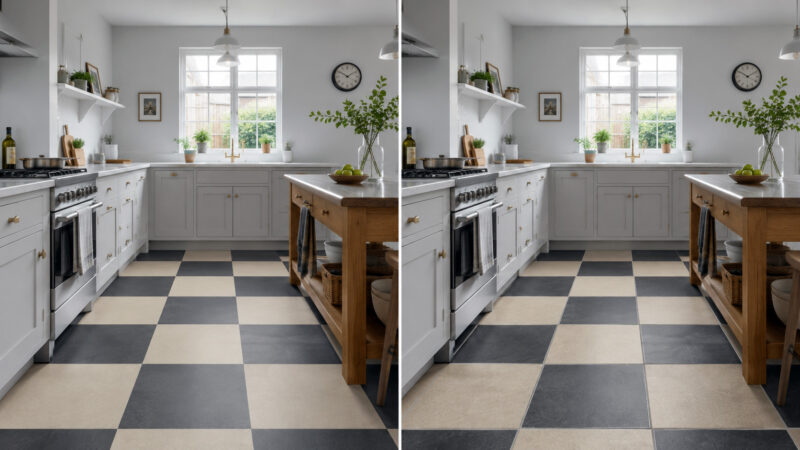
Vinyl Has an Advantage in Comfort
Ceramic and porcelain create a substantial, durable surface, but they are also hard underfoot.
Vinyl tends to feel warmer and slightly more forgiving, which can matter in kitchens and other areas where people spend a lot of time standing.
Underfloor heating can alter that comparison, and some people simply prefer the solidity of tile, but comfort remains one of vinyl’s most obvious practical advantages.
Tile Provides a Different Material Experience
Even excellent vinyl remains a resilient manufactured surface.
Modern printing and embossing can reproduce stone surprisingly well, but ceramic and porcelain provide a different tactile quality.
This does not necessarily mean one looks better.
A well-designed solid-color vinyl checkerboard can be more convincing than a poor imitation of marble. The important thing is to understand what you expect from the material rather than judging everything by how closely it imitates stone.
Installation Can Change the Real Cost
Comparing only material prices rarely gives an accurate picture of the finished floor.
Ceramic and porcelain typically involve more substantial preparation, setting materials, cutting, joint spacing and grouting.
Vinyl can reduce some of that complexity and may be useful where floor build-up height is limited.
Checkerboard, however, still requires accurate layout regardless of material.
A less expensive floor installed badly is not a less expensive solution if it needs to be removed and corrected.
Water Performance Is More Nuanced Than It Appears
Ceramic and porcelain surfaces are naturally suited to moisture-prone areas when the full installation system is designed correctly.
Vinyl requires closer attention to the exact product.
Some systems are intended for these environments, while others have limitations involving joints, seams or installation method.
The word vinyl alone does not determine whether a floor is suitable for a bathroom or laundry room.
Repairs Can Favor Individual Vinyl Tiles
Some individual vinyl tile systems allow a damaged square to be replaced relatively easily.
Keeping spare tiles after installation is therefore worthwhile.
Ceramic and porcelain tiles can also be individually replaced, but removing a bonded tile without affecting neighboring pieces or the substrate is usually more involved.
Sheet vinyl is less convenient in this respect because local patches can be difficult to disguise in a geometric pattern.
Tile Often Has the Long-Term Durability Advantage
A properly selected and installed ceramic or porcelain floor can remain in service for a very long time.
Vinyl durability varies considerably more from product to product.
That makes broad claims about how many years vinyl will last less useful than understanding construction, wear layer, traffic and maintenance conditions.
For maximum hardness and long-term wear resistance, ceramic or porcelain may be the better choice.
For comfort, lower weight and renovation flexibility, vinyl may make substantially more sense.
Vinyl is not simply the cheaper version of tile. It solves a different set of practical problems.
Cleaning and Maintaining Checkerboard Vinyl Flooring
Checkerboard vinyl is generally straightforward to maintain, but the pattern can make everyday dirt more noticeable.
Dark squares may show pale dust, while lighter squares reveal marks and residue more easily. Regular maintenance is therefore more useful than occasional aggressive cleaning.
Removing loose grit is particularly important.
A soft broom, suitable vacuum setting or another non-abrasive method can prevent sand and small particles from being repeatedly ground into the surface, especially in kitchens, mudrooms and entryways.
When damp cleaning is necessary, follow the recommendations for the specific product.
Stronger cleaning chemicals do not automatically produce better results. Abrasive pads, inappropriate products and excessive scrubbing can dull or damage some vinyl finishes.
The same applies to water.
Even when the flooring has strong water resistance, routine cleaning does not require flooding the surface. Standing water around joints and perimeter edges provides no cleaning advantage.
Entrance mats and furniture pads can also make a significant difference over time by reducing grit, scratches and pressure marks.
If the floor consists of individual tiles, keeping several spare pieces after installation is useful because a damaged section may be replaceable depending on the system.
Most importantly, follow the product rather than a generic cleaning rule.
Vinyl flooring includes different constructions and surface treatments, so manufacturer care instructions should remain the main reference for cleaning products, stain treatment and repair.
For a more detailed routine, including difficult stains, cleaning methods and products to avoid, see our guide on how to clean vinyl tile floors.
FAQ About Checkerboard Vinyl Flooring
Is checkerboard vinyl flooring waterproof?
Performance depends on the specific product, installation system, seams, perimeter details and conditions underneath the floor. Always check the manufacturer’s specifications for the intended room and installation.
Is checkerboard vinyl flooring good for kitchens?
In a busy kitchen, prioritize the wear layer, surface finish, intended-use rating and water performance rather than selecting the product purely by color or pattern.
Can checkerboard vinyl be installed over an existing floor?
The existing surface needs to meet the requirements of the new vinyl system and may need to be flat, stable, clean and properly prepared. Joints, texture or unevenness underneath can sometimes become visible through vinyl or interfere with adhesion.
Avoiding removal does not necessarily mean avoiding preparation.
Is LVT better than sheet vinyl for a checkerboard floor?
LVT or individual vinyl tiles provide greater control over the actual checkerboard layout and may make local repairs easier. Sheet vinyl offers fewer seams and can incorporate the entire checkerboard pattern into one continuous surface.
Choose according to the room, installation requirements and the type of finished surface you want.
Does checkerboard vinyl flooring look cheap?
An overly glossy finish, repetitive printing, unrealistic stone effects or poorly aligned installation can make vinyl look inexpensive quickly.
Better products with believable tonal variation, subtle surface texture and a matte or low-sheen finish can produce a much more convincing result.
Installation matters just as much as the material. Even excellent vinyl will look poor if the checkerboard grid is visibly out of alignment.
A successful checkerboard vinyl floor is ultimately about more than recreating a familiar pattern.
The colors need to work with the room, the scale needs to relate to the architecture and the flooring itself has to be suitable for the traffic, moisture and maintenance the space will actually experience.
Vinyl does not need to reproduce natural stone perfectly to justify its place in a well-designed interior. Its strengths are different: comfort, flexibility, relatively low weight and the ability to create a strong geometric floor in situations where ceramic or natural stone may be less practical.
If the floor looks convincing but cannot handle the way the room is used, it is the wrong product. If it performs beautifully but the pattern feels disconnected from the architecture, it is the wrong design.
The best checkerboard vinyl flooring gets both decisions right.